




Sain baina uu! I’m Takeshi from Tsogto Mongol Horse Riding Tour.
Mongolia covers more than 1.5 million km² — almost three times the size of France — so there is no shortage of breathtaking scenery. From all of it, I have picked only places I have been to and seen with my own eyes. The first ten are around our own Erdene Tourist Ger Camp; the other ten are from across the country.
10 Views Around Erdene Tourist Ger Camp
Our camp is about 60 km east of Ulaanbaatar. Here is what you can see nearby.
1. Grassland as far as the eye can see

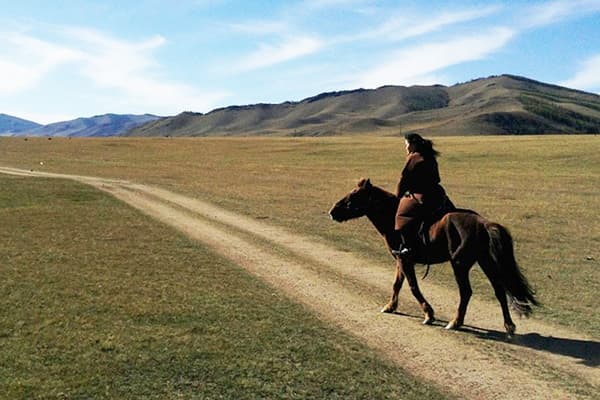
Above all, the steppe. Wherever you point your camera, it is a view. Around the camp there is plenty of short-grass steppe on gentle uphill slopes — ideal for riding fast. There are few rodent holes here, so you can gallop without worrying about the ground. We have filmed many gallops in this area, and if you want to shoot your own riding film, ask us — we can even arrange a group of nomad horsemen.
2. Starry skies right at the camp

At many tourist camps in Mongolia, the lights make it hard to see the stars. At Erdene Tourist Ger Camp we keep lighting to a minimum so it doesn’t spoil the night sky. The north-west is a little bright because of Ulaanbaatar, but in every other direction the stars are beautiful.

3. The big rock to the south

About 2 km south of the camp (as the crow flies) there is a big rock you can climb for a great view. There are no safety rails at all, so please watch your step. The rock is surrounded by gentle hills — lying in the grass and soaking up the sun there is lovely too.
4. Wildflowers on the hills

About 1.5 km east of the camp is a hill where beautiful flowers bloom at certain times of year. If you come at the right time, you can ride through the flowers. It is slightly raised, so the view is good too.
5. The Nalaikh Steppe from the mountains

Our tent-camping treks ride through the mountains south of the Nalaikh Steppe. Coming down from the mountains, the whole steppe opens up in front of you — one of my favourite moments of the ride.
6. The Chinggis Khaan Equestrian Statue

About 7 km from the camp stands the giant statue of Chinggis Khaan on horseback. Inside there is a museum and what is said to be the biggest boot in the world, and you can walk out onto the horse’s head for a view from high above. Full guide: Chinggis Khaan Equestrian Statue.
7. The Tuul River

About 2 km north of the statue flows the Tuul River. Around 50 km upstream is Balhin Chuluu, near the river’s source. The river is so clear that we sometimes camp beside it on our treks — falling asleep to the sound of the water is wonderful. (Photo: the Tuul in September.)
8. Flowers on Tamganuu Undur

On our tent-camping treks, we reach Tamganuu Undur on the second day. Depending on the season it is covered in flowers. The view from the top is lovely (it is more a chain of rolling hills than a mountain), and with no lights anywhere around, the stars are spectacular.
9. A nomad family’s gers

An hour’s gentle ride from our camp is the ger camp of the nomad Nyamochir. Our guests call him “Yusuke” — a nickname a Japanese guest once gave him — while the local herders call him Gorgoo. He is a leader among the families here, and they work together to raise and protect their horses and livestock. You can experience nomadic life at his gers, and because guests sleep in their own ger, it is a fairly comfortable way to do it.
10. Gorkhi-Terelj National Park

Across the Tuul River from our camp lies Terelj, full of huge, strangely shaped rocks — one even looks like the Buddha. The park is packed with tourist camps, and at night you may hear music drifting over from young people dancing somewhere. Join in if you like — but watch out for drunks! Full guide: Gorkhi-Terelj National Park.
Turtle Rock: the park’s most famous sight, a huge rock that looks like a turtle. You can climb it for the view, but the way up is slippery rock, so take care.

Aryabal Meditation Temple: further in from Turtle Rock, a colourful Tibetan Buddhist temple, still used for practice. It sits high up at the top of a steep staircase, and the view from there is stunning.

10 Views from Across Mongolia
There are countless famous and unknown viewpoints across Mongolia. Please forgive me for including only places I have seen myself.
11. The hills on the Russian border, Selenge

Near Sükhbaatar City in Selenge Province, northern Mongolia, the border area with Russia has an incredible view — I have been three times. It is windy and very cold, but standing in that wind looking out, all sorts of thoughts pass through your head. Note that foreigners generally need a permit to enter border areas, and at the moment I would not recommend going close to the Russian border.
12. Eej Mod, the Mother Tree

Also in Selenge Province, the “Mother Tree” is a place of worship where wrestlers and other competitors come to pray before a contest, and you will see people praying devotedly to the tree. In winter the roads are covered in snow and it is hard to reach.
13. The giant Buddha at Gandan Monastery

Mongolia’s largest Tibetan Buddhist monastery, in the centre of Ulaanbaatar. Its grounds hold many buildings, and the one in the photo houses a huge Buddha statue. A short walk south of it, in a newer building, you can watch monks praying together and have your fortune told (in Mongolian). You decide how much to pay; 10,000–20,000 MNT is typical. In my view, Tibetan Buddhist fortune-telling is less about seeing the future and more about praying for it — unlike shamans, who look into it. More: things to do in Ulaanbaatar.
14. Lake Khövsgöl

In Khövsgöl Province in the far north, this is one of the clearest lakes in the world and holds most of Mongolia’s fresh water. Sometimes called the “Switzerland of Mongolia”, it is a famous destination. There are two main areas: the Khatgal side in the south, lined with tourist camps, and the Jankhai side further up the shore. Both are lovely, but I prefer Jankhai — it feels more remote, and many gers look straight out over the lake.
The Dukha (Tsaatan) people, who herd reindeer, live in the taiga around the lake. Some families live near the tourist areas, but those who keep the traditional way of life are deep in the mountains, without phones, living with nature. Visiting them is not normally possible, but Tsogto runs trips to see them — ask us if you are interested.
15. Khongor Sand Dunes

The Gobi stretches across southern Mongolia into China. Most of it is rough, scrubby land rather than the sandy desert people imagine, but the Khongor dunes are huge and beautiful — the finest in the Gobi. Sunrise and sunset on the dunes are unforgettable.
16. Bayanzag, the Flaming Cliffs

Known as the Flaming Cliffs, and famous for the dinosaur fossils and eggs found here. The cliffs glow red in the evening light, so try to visit at sunset.
17. Yolyn Am

A gorge said to be home to rare animals such as snow leopards. It stays so cool that ice can remain in the river until early summer. Exploring it on horseback is a real pleasure.
18. Kharbalgas

The place that left the deepest impression on me: the ruins of the palace of the Uyghur Khaganate, north of Kharkhorin. The palace site is in the centre of the photo, surrounded by the remains of the city walls. The land around is perfectly flat grassland for kilometres — lying down there felt amazing.
19. The Orkhon Valley
A UNESCO World Heritage Site where Mongolia’s history and nature meet. Carved by the Orkhon River over thousands of years, the green valley appears in the middle of the steppe like an oasis. Herding families still live here, and it is a wonderful place for hiking and camping. More: Mongolia’s 6 World Heritage Sites.
20. Altai Tavan Bogd
On the border with China and Russia in the far west, the Altai Tavan Bogd massif includes Khüiten Peak, at 4,374 m the highest point in Mongolia. Glaciers and emerald lakes surround the mountains. Climbing is a serious challenge, but the scenery is worth every step — and you can also explore the area on horseback.
There Are Many More
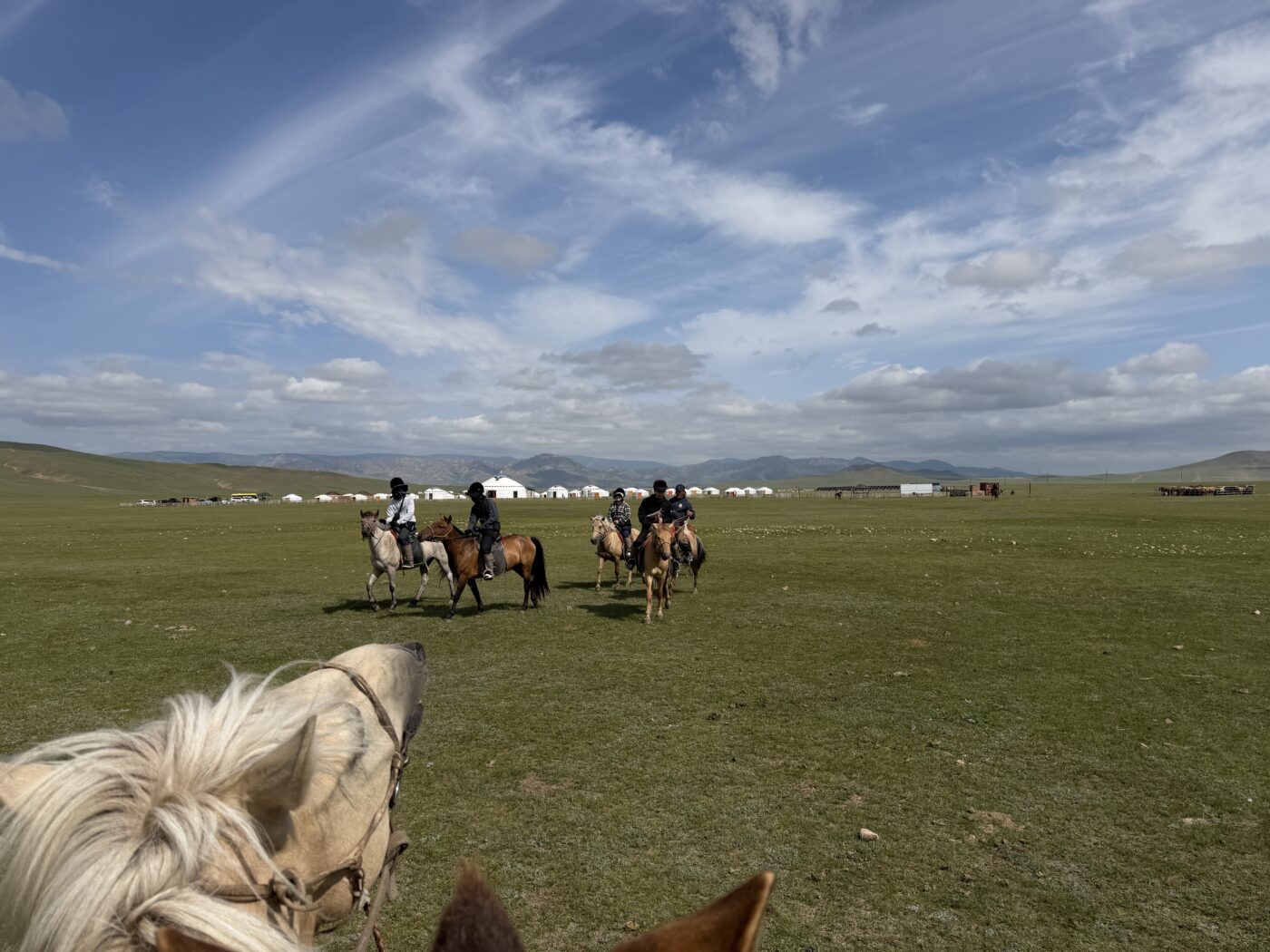
These are the views I have seen for myself — there are many more across Mongolia, so go and find your own. The easiest place to start is the steppe around our camp: our English-guided treks ride from the Nalaikh Steppe to the 13th Century Complex, or 200 km north to Gunjiin Sum Temple, camping under the stars. Questions? Contact us any time.


