





Sain baina uu! I’m Takeshi from Tsogto Mongol Horse Riding Tour.
This article is for riders who want to know how to stop a horse that has started to bolt. But let me say this first: once a horse is truly bolting, stopping it is very difficult. The most important thing for safe riding is to keep the horse under control before it ever gets to that point.
Our faster riding tours require canter experience, and we ask that riders understand how to bring a horse back from a canter — including how hard it can be.
- You have cantered on horseback before
- You know how to slow a horse down from a canter yourself, and can do it
These requirements apply to tours such as Gallop Camp and the 200 km Gunjiin Temple Expedition.
1. You Have Cantered Before
It doesn’t matter where you learned or for how long. If you have experienced the “scary” feeling of a canter at least once, that’s fine.
On our faster tours we may start cantering towards the end of the first day (depending on progress and the group’s skills). Riders who have never felt the change in speed or the riding position at a canter sometimes get frightened and fall off on their own. Trotting and cantering feel completely different, so we ask riders to know both the fear and the fun of cantering before they join.
Not sure about your level? See our riding levels guide.
2. You Can Slow Down from a Canter Yourself
Mongolian horses don’t understand subtle aids
First, Mongolian horses can’t be steered or slowed with the subtle rein aids used at riding schools. Once you and your horse have built trust, the horse may respond to small movements or even where you look — but that usually takes two or three days of riding together. On a multi-day ride you may reach that point by the last day.
Clear, simple aids
In general, Mongolian horses change speed and direction in response to clear signals:
- Turning right: move the reins to the right so the horse’s head turns right.
- Speeding up: give the horse a light kick with your legs.
- Stopping: lean your weight into the reins and pull back. How hard you pull depends on the speed.
How to Slow Down from a Canter
- Shift your weight back
- Pull the reins back
Some horses resist if you pull too hard, so feel out the right amount of pressure as you ride. Increase the pressure gradually, as if you are telling the horse “I’d like to stop now.” Normally this is enough for the horse to slow down and stop.
Note: when stopping from a canter, let the horse walk for a while before coming to a full stop. Stopping suddenly is bad for the horse’s legs.
Even nomads struggle to stop a horse at full gallop
Once a horse has picked up speed and moved from a canter into a full gallop, stopping it takes great strength — even for nomads. A racehorse running flat out is very hard to stop by force. It only stops when the rider throws their whole body weight back and pulls with everything they have, and that skill takes Mongolians a lot of practice too.
A safe canter
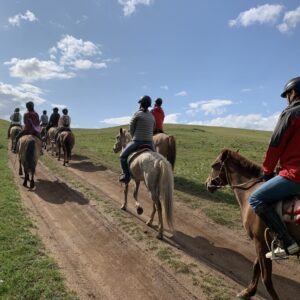
This video shows a safe canter: the group moves from a walk into a canter, and at the end we slow down when the horses start to go a bit faster. It was the first day of our 2022 Gunjiin expedition, which covers longer distances, so we often ride at this speed from day one.
Everyone is riding well and looks relaxed. At this speed, riders can still stop their horses themselves. This is the speed to keep to.
A dangerous canter (close to a gallop)
Now look at a horse that can no longer be stopped.
The grey horse coming from the back is bolting. It used to be a horse that didn’t run much, but after a guide had ridden it fast for several days, it started breaking into a run at the slightest signal and wouldn’t stop.
The rider is one of our guides. You can see him leaning back and using his whole body to stop it — and still it doesn’t stop. Horses are herd animals, so when the horses around them start running, they run too. A bolting horse nearby can set off the others, so it should be ridden away from other horses, and the riders around it should shorten their reins in advance so their own horses don’t join in.
Can a horse run itself to death?
Running flat out puts an enormous strain on a horse. A bolting horse may ignore the rider and keep going to its limit. Horses have great stamina, but running at full speed for too long can overload the heart and lungs and, in the worst case, be fatal — racehorses have been known to collapse suddenly. That is why controlling the speed before a horse bolts is so important for both horse and rider.
Why Horses Bolt
There are many reasons, but the main one is fear. Some horses bolt the moment they see a loose stirrup swinging around after a rider’s foot slips out; others take off because a mouse suddenly appears on the ground. You need to ride in a way that doesn’t frighten the horse.
What to Do If Your Horse Bolts
- Head for ground where the grass is short and you can see the surface
- Turn the horse’s head to one side
- Ride up a gentle slope
- Keep your feet from getting caught in the stirrups
1. Ground with short grass
Where you gallop should be safe. Short grass lets the horse see holes such as rodent burrows. You want to avoid the horse stumbling into a hole, or jumping sideways to avoid one it spots at the last second. And if the horse does have to jump sideways, a rider who is expecting it is less likely to be thrown.
2. Turn the horse’s head
Turning the horse’s head to the side slows it down. When a horse is bolting, even this takes a lot of strength, so turn its head towards whichever side is safe. Be careful — it is easy to lose your balance.
3. Ride up a gentle slope
Going uphill slows a horse down quickly — climbing is hard work. If nothing else works, give up fighting and head uphill.
4. Keep your feet from getting caught in the stirrups

This is not a way to stop the horse, but it is the single most important thing for your safety. A foot caught in a stirrup can lead to a very serious accident. Always ride with only the ball of your foot in the stirrup and your weight in your heels. You cannot reposition your feet during a gallop, so check your foot position all the time.
Don’t panic
The most dangerous thing when a horse bolts is a rider who panics. Horses sense how the rider feels — a panicking rider makes the horse panic too, so it keeps running and may even try to throw you off.
Back in 2013, before I met Tsogto, I was riding in Terelj after only a few rides, and I was given a racehorse. When there are several riders, the most dangerous horse often goes to the youngest, fittest-looking one — you can’t put an elderly rider on a risky horse.
That horse didn’t like me. The moment I relaxed, it bolted. It felt as fast as a bullet train. I had never fallen before, and somehow I stayed on without feeling afraid, but I had no idea how to stop it. I knew I should pull hard, but not where to put my weight, how to press into the stirrups or how to pull the reins, and anything I tried threatened to throw me off balance.
The horse seemed to expect me to fall as it sped up. When I didn’t, it ran towards a wood — trying to knock me off against the trees. I decided to jump, but at that speed in the trees I couldn’t. As a tree loomed in front of me I jumped — and my foot caught in the stirrup and I was dragged. That is a situation that can kill you.
Holding on to the horse’s tail to keep my head off the ground, I fought to get my foot free. Finally the stirrup released and I was thrown to the ground, safe. I could easily have died. I never rode in Terelj again.
Looking back, it was a proud racehorse, and of course it didn’t want an inexperienced rider like me on its back. Horses are that proud. Rest assured: on Tsogto Mongol Horse Riding Tour, we never put guests on racehorses.
If your horse bolts, stay calm and wait for it to stop.
For more, read our Mongolia Riding Safety Manual.
How to Keep Your Horse from Bolting
The key is never letting the horse go faster than a canter. If it starts to go faster than you are comfortable with, pull the reins firmly right away to slow down. Once a horse gets up to speed, it lowers its head and “locks” (like the bolting horse in the video), and it becomes very hard to slow down. You must slow it down before that happens.
When the horses around you start cantering, or a cantering horse passes right beside you from behind, your horse will want to join in. When you see that coming, shorten your reins in advance or move away.
Always paying attention so your horse never goes faster than you can handle is the surest path to safety.