



Sain baina uu! I’m Takeshi from Tsogto Mongol Horse Riding Tour.
Money is one of the first things to sort out when you plan a trip to Mongolia. In this guide I’ve put together what you should know before you go: the local currency, where to change money, using ATMs and credit cards, and how much to budget for your free time.
Quick summary
- The currency is the Mongolian tugrik (MNT). In late 2026, 1 US dollar is about 3,600 MNT.
- The easiest place to change money is the 24-hour exchange desk at the airport. Exchange shops in Ulaanbaatar give better rates.
- Visa and Mastercard work in hotels, restaurants and big stores in Ulaanbaatar. In the countryside, cash is king.
- On our English-guided tours, you pay the tour fee in cash (US dollars or Mongolian tugrik) on arrival in Mongolia. Bring a little extra cash for drinks, souvenirs and tips.
The Mongolian Currency
Mongolia’s currency is the tugrik (written MNT or ₮, and often “tg” locally).

The larger banknotes show Chinggis Khaan, Mongolia’s national hero. Notes under 1,000 MNT show Sükhbaatar, the hero of the 1921 revolution. Coins used to exist, but they are no longer in use.
Exchange Rate
As of November 2026, 1 US dollar is about 3,600 MNT, and the rate has stayed close to that level over the past year. Rates change every day, so check the latest rate before you go:
Do You Need to Change Money?
If you join one of our tours, almost everything is included in the tour price, so you won’t need much local money on the steppe. At Erdene Tourist Ger Camp and our tent campsites, drinks and souvenirs can be paid for in US dollars (cash).
Please note that on our English-guided tours, you pay the tour fee in cash (US dollars or Mongolian tugrik) on arrival in Mongolia — no payment is needed when you book. Please bring the amount in cash.
If you plan to explore Ulaanbaatar on your own, eat out or travel to other regions, it’s a good idea to carry some tugrik.
Which Currencies Can You Use?
The tugrik is the main currency. US dollars are accepted in some places, such as some hotels, but you should think of the tugrik as the default for everyday payments.
Where to Change Money
At the airport
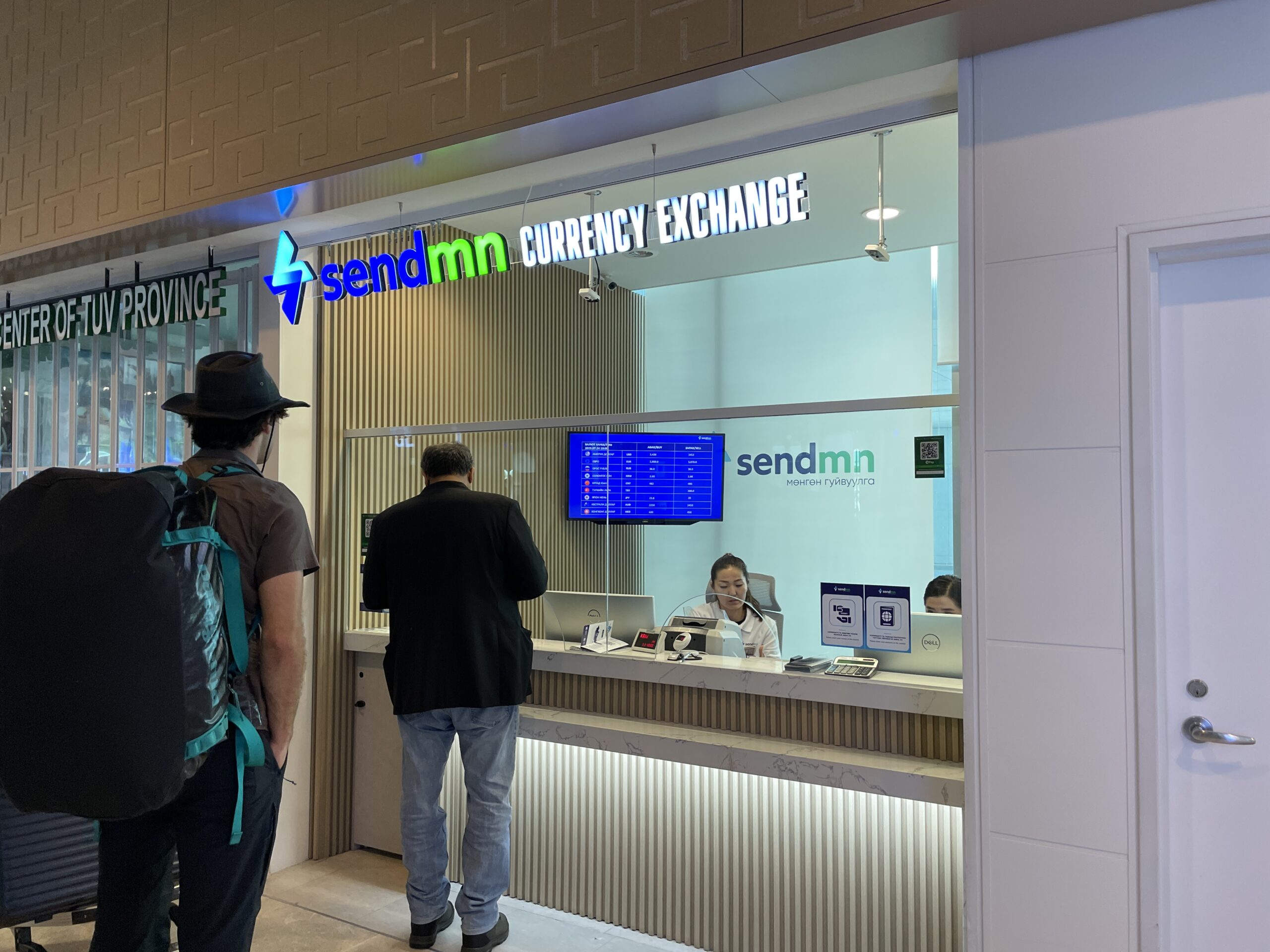
There is a 24-hour exchange desk on the 1st floor of the arrivals hall at Chinggis Khaan International Airport. The rate is a little worse than in the city, but for convenience we recommend changing some money right after you land. In summer, though, the queue can get long.
Cash withdrawal at an ATM

You can also get tugrik without changing money by withdrawing cash from an ATM with your debit or credit card. Credit card cash advances usually charge interest from day one, so pay them back as soon as you can. Check the fees with your card issuer before you travel.
Things to watch out for at ATMs
The machine may keep your card
At the old airport, ATMs sometimes swallowed cards. We don’t know whether this still happens at the new airport, but once a card is swallowed, you can only get it back during bank opening hours — so at night, you’ll have to wait until the next day. If it happens, wait there to see whether the card comes back out; if it doesn’t, call your card company to block it.
I’ve used ATMs in Mongolia many times and it has never happened to me, but I have seen it happen to someone else. Newer machines seem less likely to do this, but it’s a risk worth knowing about. Bringing a second card is a good backup.
Withdrawal limits
Check your card’s daily withdrawal or cash advance limit before you leave. If it’s low, ask your bank to raise it — this can take a few days, so do it early.
Be aware of your surroundings
More than ten years ago there were cases of people being robbed after using an ATM. We rarely hear of this now, but don’t let people see where you put a large amount of cash. Skilled pickpockets in Mongolia can take the money out of your wallet without you noticing.
Changing Money in Ulaanbaatar
In Ulaanbaatar you can change money at banks, hotels and exchange shops. US dollars, euros and other major currencies are easy to exchange.
Banks
Banks are everywhere in the city and easy to spot — just look for the word “BANK.” Queues can be long, and it may take up to an hour. You’ll need your passport, so don’t forget it.
Hotels
Many hotels can change money. The rate is usually the worst, but there’s rarely a queue. For small amounts the difference is minor, so it’s handy if you’re short on time.
Exchange shops
Private exchange shops usually offer better rates than banks, so they’re the best choice for larger amounts. Exchange shops are often clustered on the same street, and each one shows its current rates on a board.
The board shows two numbers for each currency. Look at the “АВАХ” (buy) column for your currency and compare a few shops — the higher the number, the more tugrik you get.
Show your money to the staff and they’ll show you the amount on a calculator. Always count the money you receive on the spot. Foreigners are sometimes given a little less than they should be.
You may see people standing outside exchange shops holding cash, offering a better rate than the shop. We recommend not using them. In the past, there was a case where someone took the money, shouted “Police!” and ran off with it.
Watch out for pickpockets after changing money
Put your money away inside the shop and leave quickly. Pickpockets may be watching.
Exchanging money outside Ulaanbaatar
You can also change money in regional towns, at banks and ATMs in the town center. These towns are not especially dangerous, but if people notice you’re carrying a lot of cash, someone might be tempted — so be careful, for everyone’s sake.
If an ATM in a regional town swallows your card, it is very unlikely you will get it back. It’s safest to withdraw what you need in Ulaanbaatar.
Using Credit Cards in Mongolia
Which cards are accepted?
Visa and Mastercard are the most widely accepted. JCB and American Express are accepted in far fewer places, so bring a Visa or Mastercard if you can.
Where cards are accepted
- Mid-range and upscale hotels in Ulaanbaatar
- Restaurants and cafés popular with visitors
- Large supermarkets and department stores
- Some souvenir shops
Where cards are hard to use
- Regional towns and nomad gers
- Local markets (such as Narantuul Market and Bayanzurkh Market) and small shops
- Taxis (except some app-based services)
- Street stalls
In these places, expect to pay cash in tugrik.
Tips for using cards
- Use contactless payment where you can. Avoid handing your card to staff; ask them to process the payment in front of you.
- Check for fees. Some shops add a surcharge for card payments, and your card company may charge a foreign transaction fee.
- Be careful with your card details. We haven’t heard of skimming cases, but it can happen anywhere, so keep an eye on your card.
- Have cash as a backup. In Ulaanbaatar, payments rarely fail because of a bad connection, but in the countryside it happens often.
Can You Pay in US Dollars?
There are some places in Mongolia where you can pay in US dollars instead of tugrik.
- Ulaanbaatar: some hotels accept dollars, but the tugrik is the norm, and the exchange rate is set by the hotel or shop.
- Tourist sites and gers in the countryside: small amounts of dollars may be welcome for souvenirs or activities such as horse or camel rides. Change may be given in tugrik — or not at all — and the rate may be up for negotiation.
- Tips: US dollars are handy for tipping.
- Note: large notes are hard to use. Plan to pay in tugrik for most things.
Where you’ll need tugrik in cash
- Entrance fees for national parks and protected areas (especially in the countryside)
- Small museums and temples outside the city
- Stays and meals at nomad gers (when not included in a tour)
- Activities such as horse or camel rides (if you arrange them yourself)
- Local markets and street stalls
- Local canteens and small shops in the countryside
- Public transport (city buses, long-distance buses)
- Taxis (especially ones you flag down on the street)
- Small tips
Places where cards usually work
- Major museums in Ulaanbaatar (such as the dinosaur museum)
- The Chinggis Khaan Equestrian Statue (entrance fee by card; eagle photos and camel rides can be paid in US dollars)
- Traditional performance venues in Ulaanbaatar (Tumen Ekh and Hun Theatre accept cards)
Prices in Mongolia
Prices in Mongolia rose sharply after the pandemic — many things cost nearly twice what they used to — so it’s not as cheap as some people expect. Here are some typical prices (dollar amounts are approximate, at about 3,600 MNT to the dollar):
| Item | Price |
|---|---|
| Bottled water (500 ml) | 2,000 MNT (about $0.55) |
| Canned beer (500 ml) | 3,000 MNT (about $0.85) |
| Tsuivan (fried noodles with meat) | 18,000 MNT (about $5) |
| Taxi in Ulaanbaatar, per km | 2,500 MNT (about $0.70); 1,000–1,500 MNT outside the capital |
| Ice cream | 2,000 MNT (about $0.55) |
Budget for Your Free Time
Here’s a rough budget for sightseeing and shopping in Ulaanbaatar outside your tour.
| What | Typical cost |
|---|---|
| Lunch at a mid-range restaurant | About $6–10 per person |
| Dinner at a nicer restaurant | About $14–28 per person |
| Small souvenirs | From about $20 in total (cashmere costs much more, but most cashmere shops accept cards) |
| Traditional performance (Tumen Ekh, Hun Theatre) | About $14 per person (cards accepted) |
| Gandan Monastery / museums | About $3 / about $3.50–7 |
| Taxis | About $0.70 per km — $20–30 is plenty for a few days |
Watch out for overcharging taxis. Traffic in the city center is heavy, so walking is often faster.
Summary
- Change a little money at the airport when you arrive; use exchange shops in the city for larger amounts.
- Bring a Visa or Mastercard, plus a backup card.
- Carry tugrik in cash for the countryside, markets and taxis.
- On our English-guided tours, bring the tour fee in cash (US dollars or tugrik) — you pay on arrival.
Use cash, cards and ATMs wisely, and enjoy your trip to Mongolia!